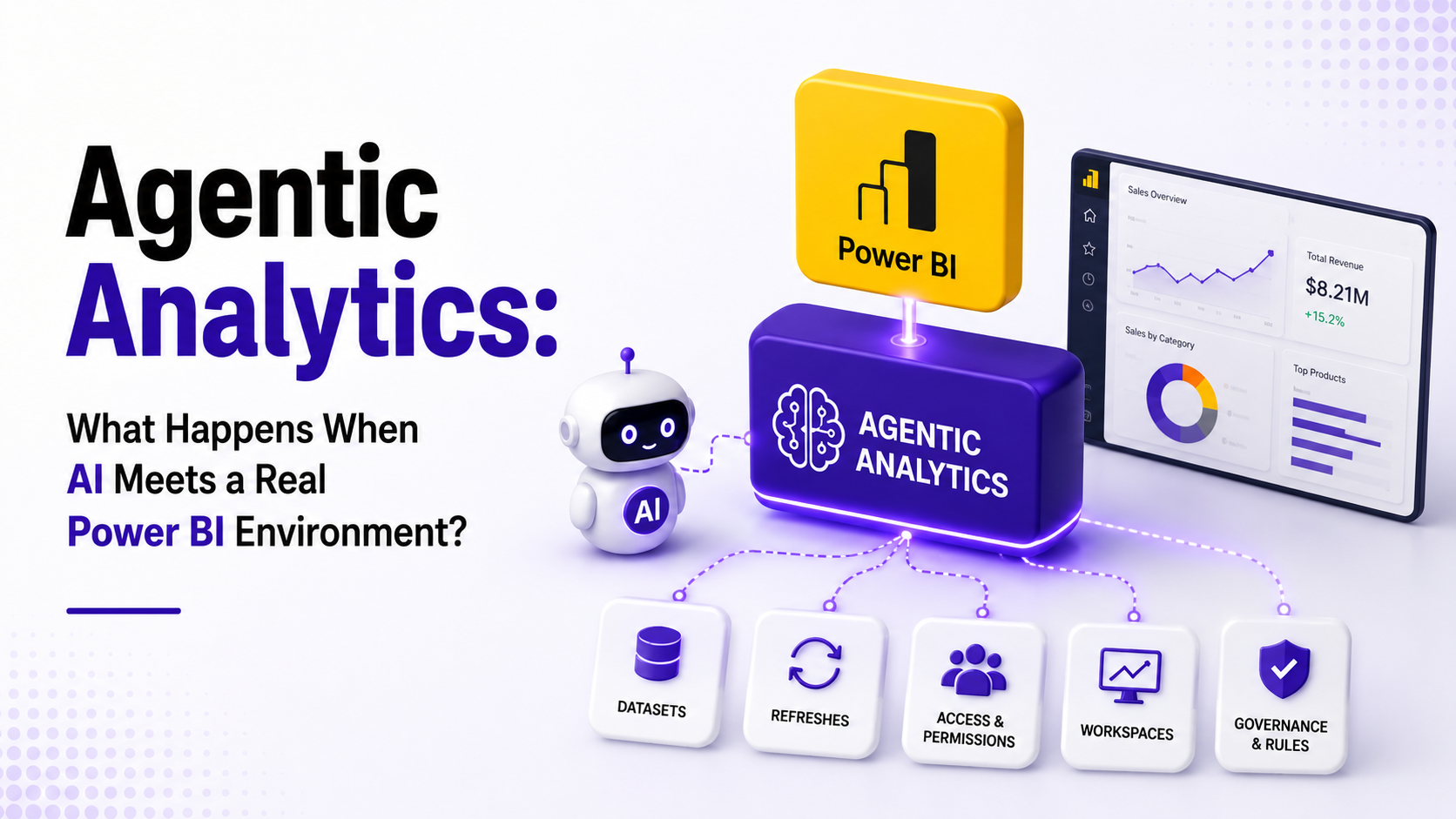
Much of the conversation around AI focuses on what these systems will be able to do. Answer questions, investigate trends, generate insights, and help users make decisions faster.
The harsh reality is that AI won't operate in a perfect reporting environment. Two reports show different numbers. A KPI suddenly changes after a deployment. A business user asks where a metric comes from. A measure exists, but nobody remembers why it was created. A dataset has dozens of reports connected to it, and nobody is quite sure what might break if a change is made.
For Power BI teams, these situations are very common. The interesting question is what happens when AI starts helping answer business questions and investigate data. Before AI can solve these problems, it first has to navigate them.
In this blog
- A KPI suddenly changes. Where do you start?
- The expert is on leave. Now what?
- Three reports show three different answers. Which one is right?
- What does AI actually need to investigate and explain data?
- Will dashboards remain relevant in an AI-driven world?
A KPI Suddenly Changes
Everything looked fine yesterday. This morning, a business user notices that a KPI has dropped by 25%. The immediate reaction is often to understand whether the change is real or if something behind the scenes has changed. Teams start checking refresh history, recent deployments, source data updates, and calculation logic. What appears to be a simple KPI question can quickly turn into a much broader investigation.
The challenge isn't finding the KPI. The challenge is finding everything that influenced it. This is one reason metadata, lineage, and dependency tracking become increasingly valuable as Power BI environments evolve. Not because these are governance requirements,because they help teams understand what changed, where it changed, and what may have been impacted as a result.
Agentic analytics faces a similar challenge. Before an AI agent can explain why a KPI moved, it first needs a path to investigate. Metadata, lineage, and dependency information can provide that path.
Instead of stopping at the KPI value itself, an AI agent can follow relationships between reports, semantic models, datasets, and source systems to identify potential causes and narrow down where the change may have originated.
The more visibility that exists across the reporting environment, the easier it becomes for both humans and AI to answer simple question: What actually changed?
Related reading: How Metadata Helps Power BI Teams Understand Their Environments
An AI agent can only investigate what it can trace
When a KPI suddenly changes, these signals help narrow down what changed and where.
The Expert Is on Leave
Every Power BI environment seems to have one expert. The person who knows why a KPI was calculated a certain way. The person who remembers why a business logic was introduced. The person everyone messages when a number doesn't look right.
Most of the time, this works fine. Until that person goes on leave, changes teams, or moves to another role.
Suddenly, questions that used to take 5 minutes to answer become much harder. Teams spend time searching through reports, old emails, documentation, and meeting notes, trying to understand decisions that were never formally captured.
This becomes particularly important in an agentic analytics world. Imagine an AI agent detects an unexpected KPI change. It investigates the likely causes, identifies the impacted reports, and determines that further action is required.
What happens next is more critical? Should a ticket be created? Who should review the findings? Who owns the KPI? Who can approve a change if needed?
Without clear ownership, the investigation often stops at a recommendation. With clear ownership, the agent has a path to continue the workflow by routing the issue to the right people and providing the context needed to make a decision.
The less an organization depends on individual experts, the easier it becomes for both humans and AI to move from insight to action.
An AI agent can recommend actions, but someone still needs to own them
These signals help move investigations from recommendations to decisions.
Which Report Should We Trust?
One of the biggest assumptions in agentic analytics is that there is a single source of truth waiting to be discovered. In reality, many Power BI teams know, it is rarely that straightforward.
Ask five analysts where a particular KPI lives, and you may get several different answers. Not because anyone is wrong, but because reporting environments evolve over time. New reports are created, datasets are duplicated, and business requirements change.
Imagine asking an AI agent why a certain KPI is declining. Instead of finding a single report, it discovers multiple dashboards, datasets, and KPI definitions that all claim to answer the same question.
Before the agent can investigate the trend, it first needs to determine which source represents the approved business definition.
This is where semantic models, certified datasets, and KPI standardization become valuable. They help reduce the time spent deciding where to start, allowing both humans and AI to focus on understanding the problem rather than finding the right report.
An AI agent needs a trusted place to start
These signals help identify the organization's preferred source of truth.
Will AI Replace Power BI Dashboards?
It's a question that comes up frequently whenever agentic analytics is discussed. If an AI agent can answer questions, investigate trends, and explain results, why would anyone still need dashboards?
The assumption behind the question is interesting because it treats dashboards as a way of accessing information. But information has never really been a scarce resource.
A dashboard shows the same KPI to hundreds of users and gives everyone a common starting point for discussion. An AI agent, on the other hand, can create a different analytical journey for every user, every question, and every interaction.
That creates an interesting challenge. If ten users ask the same business question and receive ten different explanations, recommendations, or lines of investigation, how do organizations maintain alignment? How do teams ensure that decisions are still being made from a shared understanding of the business?
Perhaps the future is not dashboards or AI. Perhaps it is dashboards for alignment and AI for exploration. Because while AI may change how we consume analytics, organizations will still need a common view of performance, priorities, and business outcomes. And that may be the reason dashboards remain relevant for much longer than many people expect.
Comments
Join the discussion below (GitHub login required), or share your thoughts on LinkedIn . I’m most active there.